


How Push-Pull Force Gauges Work & Selection Guide
22-10-2026
When performing tension and compression testing, a push-pull force gauge serves a straightforward purpose: it detects a physical reaction under load and translates it into a measurable force value. While different models use distinct internal mechanics, the core measurement principles generally fall into three categories: spring deformation, electrical resistance strain, and the piezoelectric effect.
1. Mechanical Force Gauge: Spring Deformation
Mechanical force gauges measure force through the deformation of a spring or other elastic element, based on Hooke's law: F = k × X
Within the elastic limit, the deformation of a spring or elastic element is proportional to the applied force.
When a pushing or pulling force is applied, the internal spring deforms. A mechanical transmission mechanism, such as a lever or gear mechanism, amplifies this deformation and moves the pointer on the scale.
The pointer position corresponds to the applied force, allowing the user to read the force directly from the dial.
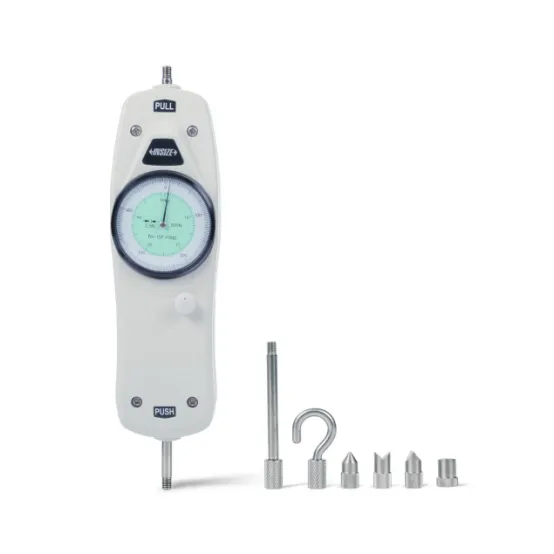
The INSIZE ISF-HF Series is a mechanical force gauge for push and pull testing. It features a precision internal design and metal case, with peak or tracking mode for force measurement.
2. Digital Force Gauge: Resistance Strain Measurement
Digital force gauges typically measure force by detecting the change in electrical resistance of a strain gauge attached to an elastic element.
When an external force is applied, the elastic element deforms, causing the strain gauge to change shape and its electrical resistance to change. A Wheatstone bridge circuit detects this resistance change and converts it into an electrical signal.
A Wheatstone bridge circuit detects this resistance change and converts it into an electrical signal.
The signal is then processed electronically and converted into a digital force value shown on the display.
Compared with a mechanical pointer gauge, a digital force gauge can provide additional functions such as peak measurement, data storage, tolerance testing, and data transmission.
The INSIZE ISF-DF Series provides peak and tracking modes, tolerance testing, 1000-memory storage, and data transmission to Excel.
The series also offers internal and external sensor configurations. Different models cover different force capacities, from small-force measurement to higher-load applications.
3. Piezoelectric Force Measurement
Another force measurement principle is the piezoelectric effect.
When force is applied to a piezoelectric material, it generates an electrical charge. The generated charge is related to the applied force. By measuring the change in charge, the applied force can be determined.
Piezoelectric force measurement responds quickly and is suitable for high-frequency dynamic testing.
However, the force gauge types most commonly used in general industrial and laboratory applications are mechanical gauges and resistance-strain-based digital gauges.
Mechanical vs. Digital Force Gauges
The measurement principle affects how the instrument is used.
| Feature | Mechanical Force Gauge | Digital Force Gauge |
| Measurement principle | Spring deformation | Resistance strain effect |
| Reading | Pointer and scale | Digital display |
| Power supply | Not required | Rechargeable battery |
| Data functions | Basic force reading | Peak, memory, tolerance and data output depending on model |
| Typical advantage | Simple and convenient | Higher accuracy and easier data handling |
How to Choose the Measurement Principle?
Test Complexity: For quick, routine shop-floor checks where convenience and immediate reading matter most, mechanical gauges provide reliable, battery-free operation.
Accuracy & Traceability: When specs demand higher precision (e.g., ±0.2% FS), test documentation, or automated pass/fail limits, opt for a digital gauge.
Load Range & Fixturing: For high-capacity testing or tight mounting spaces, digital models with external load sensors integrate far more easily into dedicated test stands.
Conclusion
Though force gauges come in various designs, their underlying job remains consistent: converting physical mechanical changes under load into actionable data. Understanding whether your application benefits from a rugged mechanical spring mechanism or a data-driven digital strain gauge ensures reliable, repeatable test results.